Balance exercises at home can be surprisingly effective when you keep them simple, repeat them a few times per week, and progress in small steps instead of chasing “hard” moves right away.
If you feel wobbly on stairs, uneasy carrying laundry, or awkward stepping off a curb, you are not alone. Balance is a skill that blends ankle strength, hip control, core stability, and even vision. When one piece gets sloppy, the whole system feels shaky.
The good news is you do not need fancy equipment. You need a safe setup, a few repeatable drills, and a way to track progress so you do not accidentally stall out by doing the same easy thing forever. This guide walks through practical routines, quick self-checks, and smart progressions.
Safety note: if you have frequent falls, new dizziness, numbness, recent concussion, or a medical condition that affects sensation or gait, it may be wise to consult a clinician before pushing intensity. According to CDC guidance on fall prevention, reducing fall risk often starts with strength and balance training plus a safer home environment.
Why balance feels “off” at home (and what usually causes it)
Most balance problems in everyday life are not about “being unathletic,” they are about missing inputs or weak links. A few common patterns show up again and again.
- Ankles that do not react fast enough: if your foot wobbles and your ankle collapses inward, your body spends energy rescuing the position.
- Hips that do not stabilize: many people feel their knee drift inward on single-leg work, that usually points to hip control.
- Core that cannot transfer force: think of the core as the “bridge” between legs and upper body, if it leaks, balance feels messy.
- Vision doing too much work: if balance falls apart the second you look away, you may be over-relying on eyesight.
- Rushed progressions: going from two feet to advanced single-leg moves without a middle step creates fear and tension, which makes wobbling worse.
One more thing people miss: the floor you train on matters. Thick carpet, slick socks, or uneven surfaces can change difficulty a lot, sometimes in an unsafe way.
A quick self-check to pick the right starting level
Before you pick drills, spend five minutes testing your baseline. You want a level that challenges you without forcing you to “save” every rep by grabbing something.
60-second baseline checks
- Tandem stance: stand heel-to-toe like you are on a tightrope, hold 20–30 seconds each side.
- Single-leg stand: stand on one foot near a counter, aim for 10–20 seconds each side without holding on.
- Eyes-off test (only if safe): in a stable stance near support, briefly close eyes for 5–10 seconds and see how much you sway.
How to interpret it: if you cannot hold tandem stance for 10 seconds, start with supported drills. If you can hold single-leg 20 seconds comfortably, add movement challenges rather than “just longer holds.”
If any test triggers sharp pain, spinning dizziness, or a feeling that you might fall, stop and scale down. In real life, “harder” is not better if it teaches your nervous system to panic.
The 10-minute routine: simple balance exercises at home (no equipment)
This is a friendly, repeatable circuit you can run 3–5 days per week. Keep a chair or countertop within reach. The goal is smooth control, not heroic struggle.
Warm-up (2 minutes)
- March in place: 30–45 seconds, easy pace.
- Ankle rocks: shift weight forward and back, 10–12 reps.
- Hip circles: small circles, 5 each direction.
Main circuit (6–7 minutes)
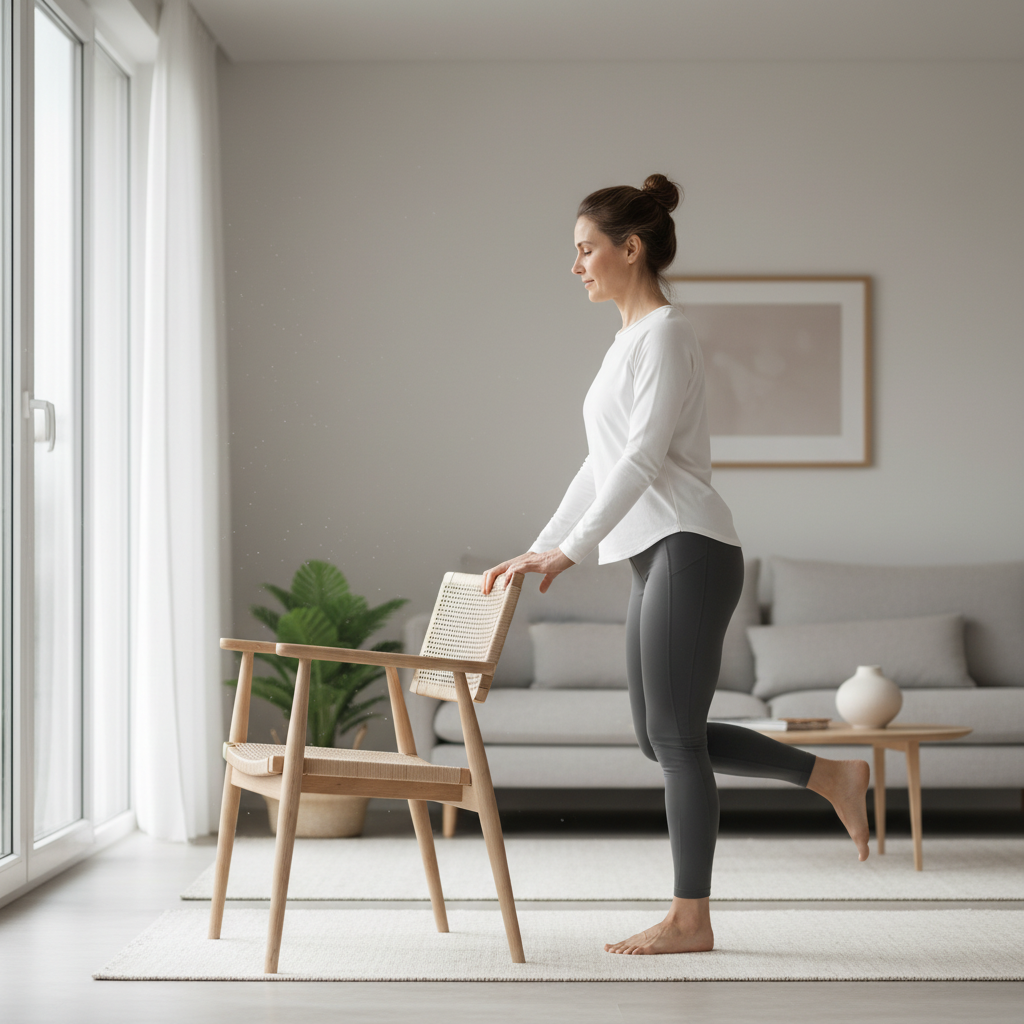
- Supported single-leg stand: 2 rounds of 15–25 seconds per side, fingertips on chair if needed.
- Heel-to-toe walk: 6–10 slow steps forward, turn around, repeat once.
- Side steps with pause: step sideways, pause 2 seconds on one leg, 6–8 steps each direction.
- Sit-to-stand with control: 6–10 reps, stand up without “plopping” back down, use hands only if needed.
Cool-down (1 minute)
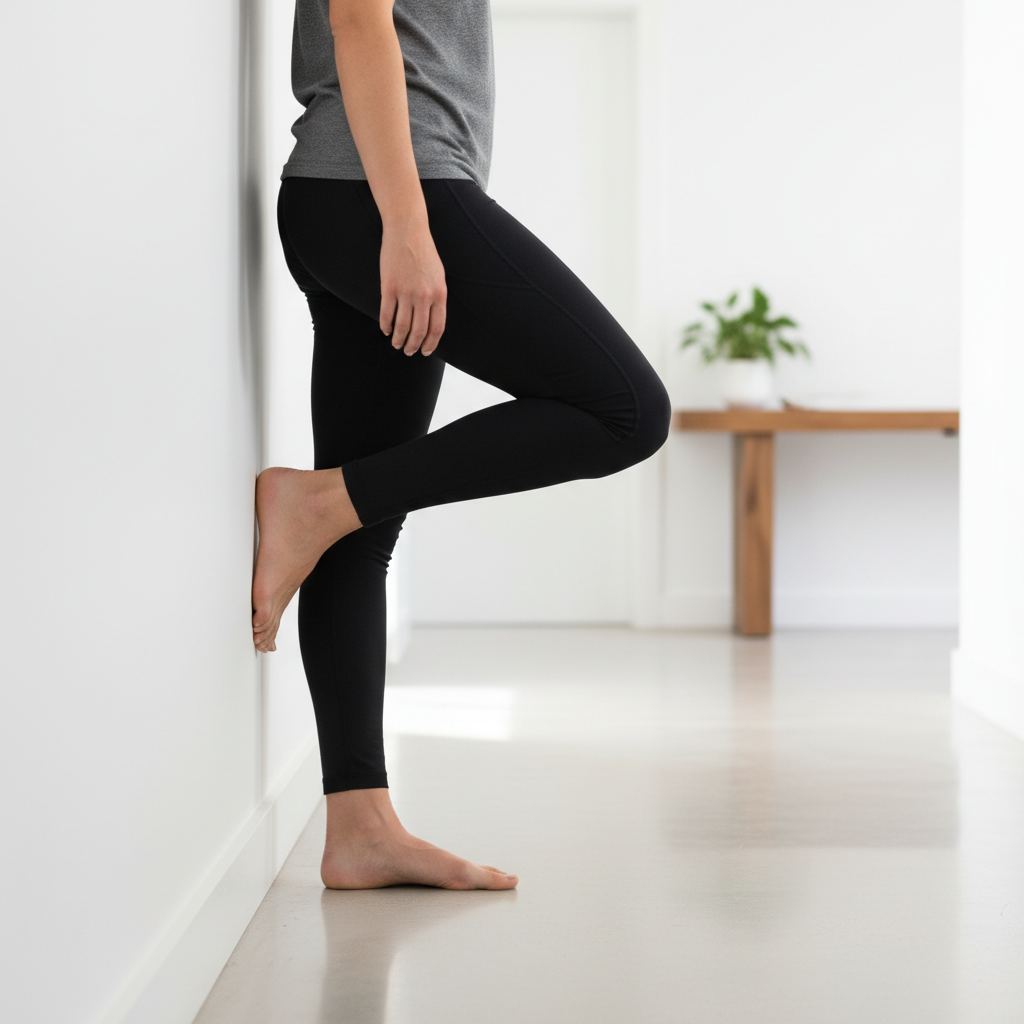
- Calf stretch at wall: 20 seconds each side.
- Slow breathing: 4–5 steady breaths to reduce tension.
Key point: these balance exercises at home work best when you treat them like practice. If you grind until your foot cramps, your form usually collapses, and you teach compensation instead of control.
Progressions that actually make you steadier (without getting reckless)
People often “progress” by making a hold longer, then wonder why they still feel unstable in real situations. Better progressions add small changes that mimic daily life.
Use one lever at a time
- Less hand support: go from full hand, to fingertips, to hovering the hand.
- Narrower base: feet hip-width, then feet together, then tandem stance.
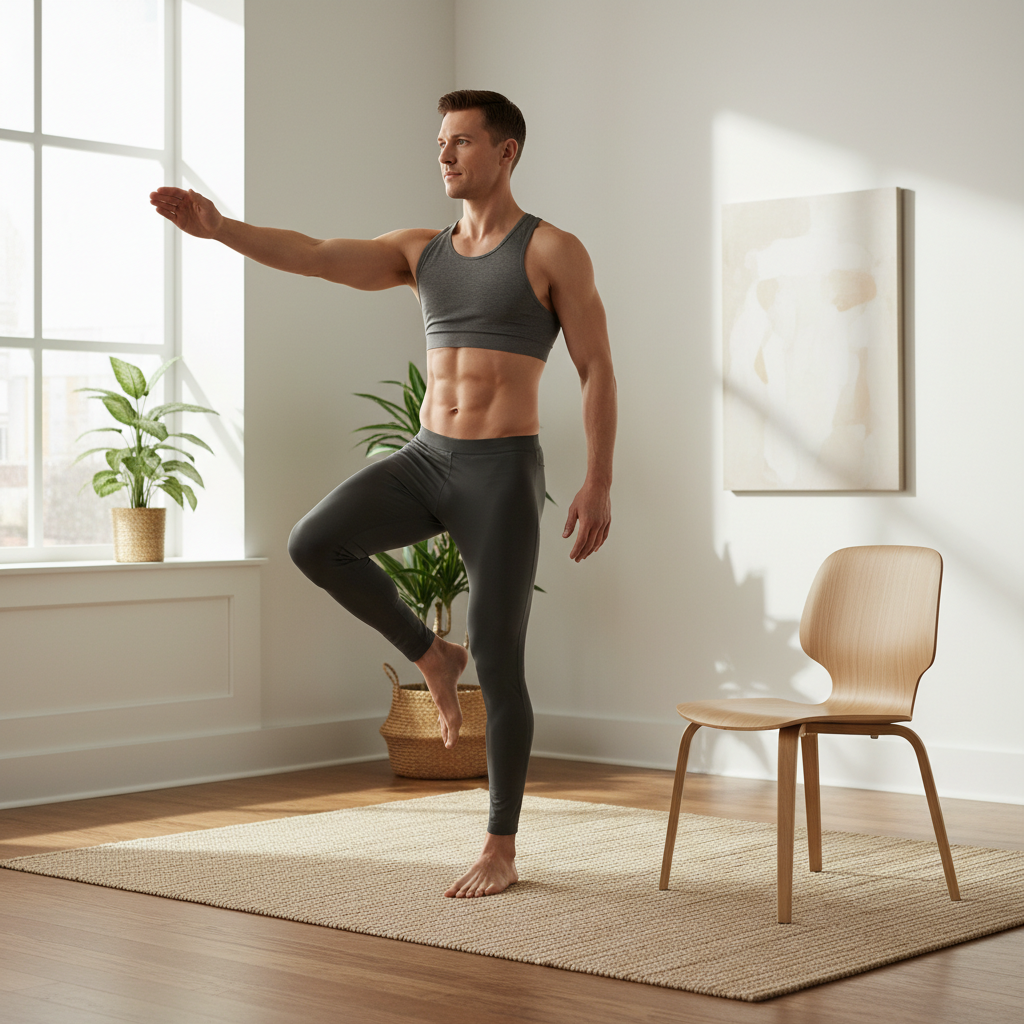
- More movement: add head turns, reach with one arm, or small knee bends.
- Softer surface (later): folded towel under the foot, only when basic stability feels solid.
If you want one simple rule, keep it: challenge without panic. A little wobble is training. Repeated near-falls are a sign you moved too fast.
According to NIA (National Institute on Aging), balance training that steadily increases challenge can support stability and help lower fall risk, especially when combined with strength work.
Choose your plan: a simple weekly schedule (with a tracking table)
You do not need perfect programming, you need consistency. Pick a schedule you can keep even on busy weeks.
- Beginner: 3 days per week, 10 minutes.
- Intermediate: 4 days per week, 10–15 minutes, add progressions.
- Plus strength: 2 days per week add squats to a chair, calf raises, and hip hinges.
Tracking table (copy into Notes)
| Exercise | Start Goal | Progress When… | Next Step |
|---|---|---|---|
| Supported single-leg stand | 15s/side | 25s is steady, minimal grabbing | Fingertip support or add reach |
| Tandem stance | 20s/side | You can breathe, shoulders relaxed | Slow head turns |
| Heel-to-toe walk | 6 steps | Foot lands controlled, no rushing | Add pause at each step |
| Sit-to-stand | 6 reps | Knees track smoothly, no collapse | Slow 3-second lower |
Quick key takeaways:
- Train near support so you can relax and learn control.
- Practice little and often beats one long session that leaves you sore and cautious.
- Progress with small changes like reach, head turn, and reduced support.
Common mistakes and safety tips (this is where most people get stuck)
A lot of frustration comes from doing the right exercises in the wrong way. These are the traps I see most often in home routines.
- Training in socks on slick floors: barefoot or grippy shoes often feel safer, depending on your home.
- Holding your breath: breath holding can spike tension and make you shakier, exhale slowly instead.
- Staring at one spot forever: that helps at first, but later you should practice looking around, since real life demands it.
- Skipping strength: if your legs fatigue fast, balance work becomes “survival mode,” add basic strength twice weekly.
- Ignoring pain signals: muscular effort is fine, sharp pain, numbness, or joint instability is not.
According to American Physical Therapy Association (APTA), individualized assessment can matter when balance issues tie to injury, neurological conditions, or persistent mobility limits. If you suspect that kind of driver, generic drills may not be enough.
When to get professional help (and what to ask for)
Sometimes balance training at home stays frustrating because the real issue needs a closer look. It is worth reaching out if you notice any of the following.
- Repeated falls or near-falls in the past few months
- New dizziness, fainting, or vision changes
- Numbness or tingling in feet, or loss of sensation
- Post-surgery or post-injury instability that does not improve
- Strong one-sided weakness, dragging a foot, or sudden coordination changes
If you see a physical therapist, you can ask for a gait and balance assessment, a home program with progressions, and guidance on safe exposure to uneven surfaces and stairs. If dizziness is the main symptom, a clinician may also screen vestibular function, that is the inner-ear system that affects balance.
Conclusion: keep it simple, keep it steady
Balance improves when your practice matches real life: short sessions, steady exposure, and progressions that make you more capable without scaring your system. Start with the 10-minute circuit, track one or two metrics, and adjust every two weeks.
If you want an easy next step, pick one drill you can do daily near the kitchen counter, then add a second drill after one week. That small habit usually beats an ambitious plan you never repeat.
FAQ
How often should I do balance exercises at home?
Many people do well with 3–5 short sessions per week. If your sessions stay under 10–15 minutes and you recover well, daily practice can be reasonable, but keep intensity moderate.
What is the easiest balance exercise for beginners?
Supported single-leg standing near a chair is a practical starting point. You can scale it by using fingertip support and gradually reducing how much you hold on.
Do balance exercises help prevent falls?
They can help, especially when paired with leg strength and safer home habits. According to CDC fall-prevention guidance, exercise that targets strength and balance is commonly recommended, but individual risk varies.
Is it normal to wobble while training balance?
Yes, some wobble is part of the stimulus. The line you do not want to cross is repeated near-falls, breath holding, or locking up with fear, those usually mean you should scale down.
Can I do these exercises if I have knee pain?
Often you can modify, but knee pain has many causes. Try smaller ranges of motion and prioritize alignment, and if pain persists or feels sharp, consider asking a professional for a tailored plan.
Should I train barefoot or in shoes?
It depends on your feet, your floor, and what feels safest. Barefoot can improve foot awareness for some people, while supportive shoes may feel more stable for others, especially on hard floors.
How long until I notice improvement?
Some people feel more confident within a couple of weeks, while others need longer, especially if strength, sensation, or dizziness plays a role. Track simple outcomes, like steadier single-leg time or smoother stair steps.
If you are building a routine and want a more “done-for-you” approach, it can help to use a structured plan that tells you what to do each day and how to progress, especially if you tend to repeat the same easy drills or you are not sure when to level up.